
.png)

Owners often ask whether any water near the engine bay is dangerous. Others ask whether the whole area can simply be pressure-washed like the outside of the car. That is the wrong starting point. In safe engine bay cleaning, the real issue is not whether water exists at all. The real issue is where the moisture goes and what the bay is made up of. Contamination and the condition of that specific vehicle also matter.
That is why we treat engine bay cleaning as a controlled workshop decision rather than a quick rinse. Some bays can handle a careful refresh. Others need a lighter touch, more protection, and less exposure. In a few cases, the best judgement is to leave certain areas alone. We clean only where access and condition make that sensible. That matters for owners looking for engine bay detailing in Johannesburg. The same result is not appropriate for every vehicle.
Our engine-bay social video shows the visible part of that process, but it cannot show everything. It can show that the work is controlled and deliberate. It cannot show the inspection, the moisture management, or the reasoning behind what is protected, what is left alone, and what is safely cleaned.
Why “water or no water” is the wrong question
The common myth is that any water near the engine bay automatically causes damage. The opposite myth is just as risky: that an engine bay can be treated like an exterior panel and pressure-washed without concern. Both views miss the point. Water itself is not the only variable. The danger comes from the wrong technique, the wrong placement of moisture, the wrong product, or the wrong assumption about how much exposure the vehicle can handle.
When engine bay cleaning is approached properly, the aim is to remove grime without forcing contamination deeper into the bay. A strong blast can spread dirt into crevices, move residue toward sensitive areas, and leave moisture where it should not sit. That can increase the risk of corrosion over time, raise the chance of ingress into vulnerable components, and make later cleaning more difficult. Those are not guaranteed outcomes, but they are real reasons we avoid treating every bay like a body panel.
This is also why our FAQ matters. It confirms the core principle behind our approach: we avoid moisture in sensitive areas. The “why” is simple. Sensitive components, wiring, covers, openings and tired seals do not all respond to cleaning in the same way. A method that is safe for one bay may be too aggressive for another, even if both cars appear similar from the outside.
What we assess before engine bay cleaning
Before we clean anything, we inspect the bay visually. That first look tells us what is exposed, what appears sealed, where grime has built up, and which areas need to be handled carefully. We also look for modifications, signs of previous work, age-related wear, brittle plastics, heat stress and anything that suggests the bay should not receive the same treatment as a newer, simpler layout.
Vehicle condition matters because “modern” does not mean “safe for any method.” A newer car can still have exposed sensors, awkward packaging, vulnerable connectors or open areas that should not be flooded with moisture. An older bay can have tired seals or delicate finishes that deserve a lighter touch. A modified car may introduce exposed components that were never designed to be cleaned aggressively. The method changes because the bay changes.
Grime level matters too. Heat-cycled contamination behaves differently from loose dust. A heavily soiled engine bay is not automatically a candidate for stronger cleaning. In some cases, heavy contamination means we slow down, choose a more appropriate cleaner, and reduce agitation rather than increasing it. That is part of professional judgement, and it is one reason owners should not expect a one-size-fits-all engine bay wash.

How the method stays controlled
Once the condition is clear, the cleaning becomes deliberate. We do not clean by blasting and hoping for the best. We work from a controlled process that starts with protection, then product choice, then careful application, then review. The point is not to make the bay look acceptable at any cost. The point is to improve it without creating avoidable risk.
Product choice is part of that judgement. We use an appropriate cleaner for the condition in front of us rather than relying on a harsh approach for every surface. A suitable cleaner helps release dirt without forcing the process. That is especially important in engine bay detailing, where different materials, finishes and components react differently to chemicals and moisture.
Application method matters just as much. Controlled cleaning means the product is placed where it is needed, not thrown everywhere. It also means the bay is not treated as a single uniform surface. Some areas can be cleaned more openly. Others should receive minimal exposure. The engine-bay video gives owners a useful visual reference for that controlled style, but the deeper value is in the judgement behind the visual result.
We also manage rinsing and removal carefully. Moisture has to be directed and cleared, not left to sit in the wrong places. Final checks matter because cleaning is not complete when the surface first looks better. We review what has lifted, what remains, and what should be left untouched. That final assessment is part of the job, not an optional extra.
In other words, safe engine bay cleaning is not about a universal “yes” to water. It is about using the least aggressive method that still achieves the right result for that specific bay. That is the difference between a workshop process and a guess.
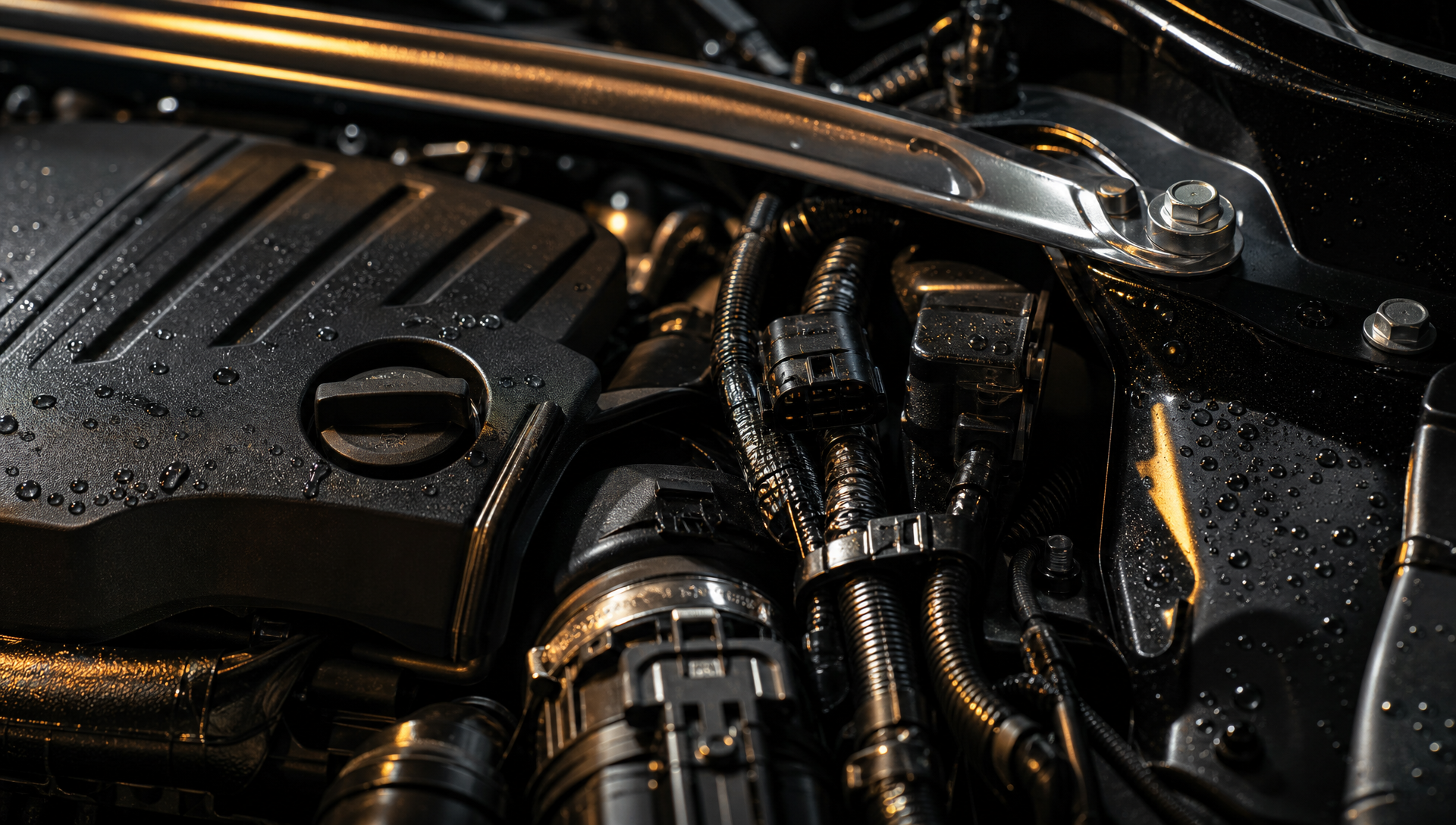
Where the decision changes
Some engine bays can tolerate more cleaning than others, but “modern” is never a blanket guarantee. The decision changes when we see exposed sensitive components, uncertain sealing, aftermarket modifications, brittle materials, heavy heat-cycled grime, or a layout that makes moisture control more difficult. Those are the moments when a cautious approach becomes the correct one.
We leave certain areas alone when the inspection shows that cleaning them would introduce more risk than benefit. That might mean protecting more and cleaning less. It might mean using a gentler product, working a smaller area at a time, or stopping short of a deeper finish where the vehicle does not justify it. Good judgement is knowing when not to push further.
This matters to owners because an engine bay can look “fine” from a distance and still contain fragile or exposed areas. A performance car, a high-value vehicle, or a car with previous modifications may need a more careful assessment than a standard commuter vehicle. The right answer depends on what the bay actually shows, not on a general rule about age or model type.
That is also why we do not endorse pressure-washing the engine bay the way someone might wash exterior panels. Exterior paint is built to be cleaned in a different way. Under the bonnet, the priority is controlled exposure, sensible product selection and a process that respects the vehicle’s condition. Those principles guide our work in Craighall, Johannesburg, and they are the same principles behind our engine bay detailing service.
What to ask before you book engine bay detailing in Johannesburg
If you are comparing options, ask questions that reveal the method rather than the promise. Ask how the bay is inspected before cleaning starts. Ask how moisture is kept away from sensitive components. Ask whether the approach changes when the vehicle has modifications, ageing materials or visible exposure. Ask what happens when the bay should only be cleaned selectively.
It is also worth asking what type of cleaner is used and why. A careful workshop should be able to explain the role of the product without hiding behind a vague “it will be fine.” Ask how rinsing, drying and final review are handled. Ask whether the team treats every bay the same or adjusts the process to the vehicle. Those answers tell you much more than a generic claim of safety.
You can also compare the explanation against the services page for engine bay detailing and the FAQ that confirms our moisture-control approach. If you still feel unsure after that, the car probably needs a professional assessment rather than a hurried clean. That is often the best point to choose controlled engine bay detailing over an aggressive or improvised wash.
A practical decision path is simple. If the bay is lightly dusty, visually stable and free from obvious exposure, a careful refresh may be appropriate. If it has sensitive components, brittle materials, modifications, unclear sealing or contamination that has built up over time, professional judgement becomes more important. When in doubt, choose the method that protects the vehicle first.
Book a professional assessment when the bay needs judgement
Water near the engine bay is not the whole story. What matters is how the bay is inspected, how the products are selected, how moisture is controlled, and how much the vehicle can safely tolerate. If you are unsure what can be cleaned or exposed, book a professional assessment and let us recommend the right approach for your car. For owners comparing engine bay detailing options in Johannesburg, that is the safest way to move from uncertainty to a controlled result.